jhcsjhcgsjzcs
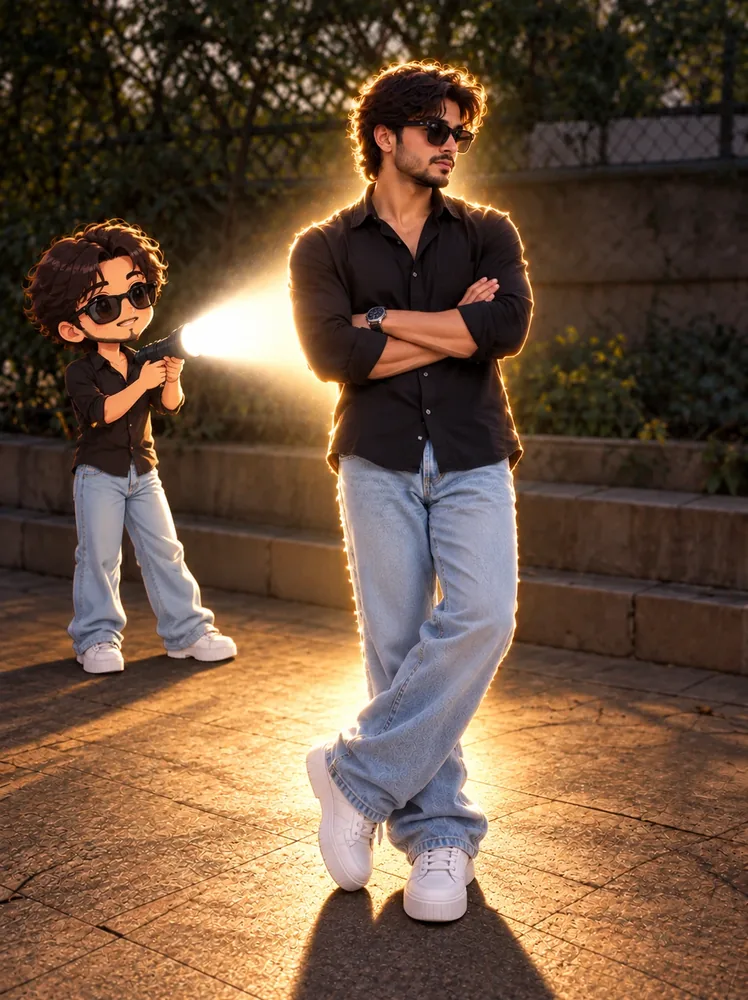
The story behind this one: the trick to an anime-fusion edit is restraint on the real side and commitment on the anime side. He stays exactly as he is — same face, same outfit, same confident stance — because the moment the “real” half looks touched up, the illusion breaks. All the drama goes into his small anime twin instead: crisp linework, exaggerated proportions, cel shading, and a flashlight beam doing the actual work of the shot. Naming the light behaviour explicitly — edge lighting, atmospheric glow, particles, a slightly darkened surround — is what stops the beam looking pasted on and makes it read as a real light source hitting a real back. Keeping the original sunset and camera framing untouched is what sells the fusion: one photographic layer, one anime layer, one believable light source between them.
The story behind this one: the trick to an anime-fusion edit is restraint on the real side and commitment on the anime side. He stays exactly as he is — same face, same outfit, same confident stance — because the moment the “real” half looks touched up, the illusion breaks. All the drama goes into his small anime twin instead: crisp linework, exaggerated proportions, cel shading, and a flashlight beam doing the actual work of the shot. Naming the light behaviour explicitly — edge lighting, atmospheric glow, particles, a slightly darkened surround — is what stops the beam looking pasted on and makes it read as a real light source hitting a real back. Keeping the original sunset and camera framing untouched is what sells the fusion: one photographic layer, one anime layer, one believable light source between them.
The story behind this one: the trick to an anime-fusion edit is restraint on the real side and commitment on the anime side. He stays exactly as he is — same face, same outfit, same confident stance — because the moment the “real” half looks touched up, the illusion breaks. All the drama goes into his small anime twin instead: crisp linework, exaggerated proportions, cel shading, and a flashlight beam doing the actual work of the shot. Naming the light behaviour explicitly — edge lighting, atmospheric glow, particles, a slightly darkened surround — is what stops the beam looking pasted on and makes it read as a real light source hitting a real back. Keeping the original sunset and camera framing untouched is what sells the fusion: one photographic layer, one anime layer, one believable light source between them.